
Apple has officially unveiled an upgraded version of its Vision Pro headset, now powered by the new M5 chip and equipped with a Dual Knit Band designed for improved comfort and balance. The refresh keeps the price steady at $3,499 (approximately ₹2.9 lakh) but brings several under-the-hood upgrades aimed at enhancing performance, battery life, and the overall user experience.
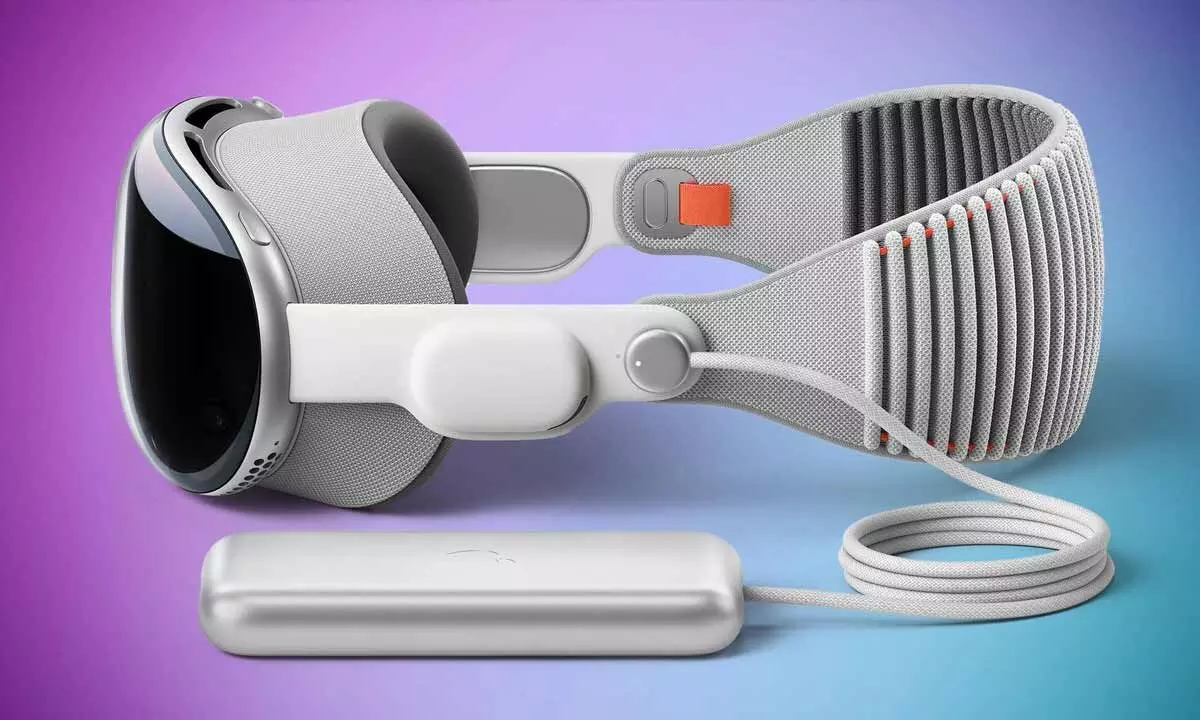
This strategic update comes just weeks ahead of Samsung’s highly anticipated Galaxy XR launch, signaling that Apple is preparing to defend its lead in the emerging mixed-reality (MR) and extended-reality (XR) market.
A Power Boost with the M5 Chip
The biggest update to the Vision Pro is its M5 processor, Apple’s latest in-house silicon designed for high-efficiency computing and on-device AI processing.
According to Apple, the M5 chip provides a 20–25% performance boost over the previous M3 variant while offering better thermal efficiency and longer battery endurance. This allows the Vision Pro to handle demanding mixed-reality applications, multitasking, and high-definition rendering with smoother results.
Developers have already reported faster scene-rendering times, better tracking stability, and near-zero lag during object interaction — all crucial elements for immersive XR experiences.
Improved Battery and Connectivity
Along with the M5 chip, Apple has optimized the Vision Pro’s battery module, which now delivers up to 3 hours of continuous use (an hour more than before). The company achieved this improvement through power management refinements and an adaptive performance mode that automatically reduces background processes when the headset detects light workloads.
Connectivity also sees an upgrade. The new Vision Pro supports Wi-Fi 7, providing faster data transfer for streaming and multiplayer XR experiences. In addition, Bluetooth 5.4 allows seamless pairing with third-party accessories like controllers, keyboards, and Apple’s own Magic peripherals.
These refinements position the device not just as a personal computing tool but also as a next-generation hub for creative professionals and gamers.
terrificwishes.com | thematchplayerstats.com | chillguymemes.com
officersdetails.com | theduaforyou.com | greblovz2004free.com
Dual Knit Band for Enhanced Comfort
One of the most discussed features of the update is the introduction of the Dual Knit Band, which replaces the original single-strap design. The new band distributes weight more evenly across the head, reducing pressure on the face and neck during long sessions.
The band is made of soft, breathable materials and can be easily adjusted for different head sizes. Early testers have described it as “noticeably lighter” and “more secure,” especially during extended use.
Comfort has been one of the main criticisms of the original Vision Pro, and Apple’s new approach directly addresses that feedback — suggesting the company is listening closely to early adopters and developers.
Same Design, Familiar Experience
Apart from internal changes and the new band, Apple has retained the Vision Pro’s overall aesthetic and design philosophy. The aluminum frame, curved front glass, and intuitive controls remain unchanged.
However, the updated VisionOS brings more refined hand tracking, eye-tracking precision, and enhanced support for 3D spatial recording. The system now integrates better with iCloud, enabling real-time syncing between devices like the MacBook, iPad, and iPhone.
The App Store for VisionOS continues to expand, with over 1,500 optimized applications now available, ranging from design tools and simulation software to streaming and productivity apps.
Apple’s Competitive Strategy Before Samsung’s Galaxy XR Launch
The timing of this announcement is no coincidence. Samsung, in partnership with Google and Qualcomm, is preparing to launch the Galaxy XR headset in late October or early November 2025. The device is expected to directly challenge the Vision Pro with a lower price and a focus on open-source Android-based XR experiences.
Apple’s move to update the Vision Pro ahead of Samsung’s event ensures it remains the benchmark for premium XR performance. By maintaining the same price while improving hardware and comfort, Apple reinforces its positioning as the “gold standard” in mixed reality — an ecosystem tightly integrated with its broader suite of devices and services.
Industry analysts believe this release could delay some potential switchers who might otherwise have waited for Samsung’s alternative. “Apple is signaling confidence,” says market expert Daniel Ives. “It’s saying, ‘We’re still leading the XR race, and we’re not waiting for anyone to catch up.’”
What’s New in VisionOS 2.1
The Vision Pro upgrade is paired with VisionOS 2.1, which brings several enhancements tailored for the M5 chip. New features include:
-
AI Scene Mapping 2.0, improving real-world object recognition and depth rendering.
-
Adaptive Lighting, which adjusts brightness and contrast based on ambient light conditions.
-
Quick Switch Mode, letting users shift between immersive mode and productivity mode instantly.
-
Eye-tracking shortcuts, allowing quick access to controls or menus simply by looking at them.
Developers will also gain access to new APIs for advanced spatial audio and gesture recognition, expanding what apps can do within the Vision Pro ecosystem.
Performance and User Experience
Early benchmarks from internal testers show that the M5-powered Vision Pro loads applications 30% faster than before, with reduced latency when switching between environments. In creative software like Final Cut Pro XR or Logic XR, users can expect smoother playback, faster rendering, and improved multi-layer editing capabilities.
Battery efficiency also plays a major role in overall experience. With the optimized system, users can enjoy longer immersive sessions — whether it’s editing 3D models, attending virtual meetings, or watching spatial movies in Apple TV+.
Sound quality has also been enhanced, with spatial audio that adapts dynamically to the user’s head position, providing a more lifelike sense of direction and space.
Market Impact and Expectations
The Vision Pro has always been more of a niche product due to its high price, but Apple’s incremental improvements could make it more appealing to professional users, developers, and early XR adopters.
According to IDC, Apple is expected to ship over 500,000 Vision Pro units globally by early 2026 — a modest number compared to iPhones but significant in the context of the emerging XR market.
Analysts predict that the M5-powered Vision Pro could serve as the foundation for Apple’s broader push into AI-driven spatial computing, merging augmented reality with on-device intelligence.
Conclusion: Raising the Bar in Mixed Reality
Apple’s latest Vision Pro refresh demonstrates the company’s steady commitment to perfecting mixed-reality experiences. The M5 chip delivers faster performance, the Dual Knit Band addresses comfort issues, and VisionOS 2.1 expands the scope for creativity and productivity.
By making these improvements without changing the price, Apple sends a clear message — innovation doesn’t always need a redesign; sometimes refinement is the real revolution.
With Samsung’s Galaxy XR set to debut soon, the competition in the XR space is heating up. But for now, Apple seems confident that the Vision Pro, in its upgraded form, will continue to define what premium mixed reality looks and feels like.