
There’s a moment that a lot of marketing leaders experience right now — usually after asking an AI assistant something like “what are the top tools for [their category]?” — where they realize their brand isn’t in the answer. Not buried. Not mentioned with caveats. Just… absent. And the competitor they’ve been neck-and-neck with for years is right there, described warmly and specifically, like an old friend the AI has known for a while.
That moment tends to prompt a fairly urgent question: what exactly does it take to fix this?
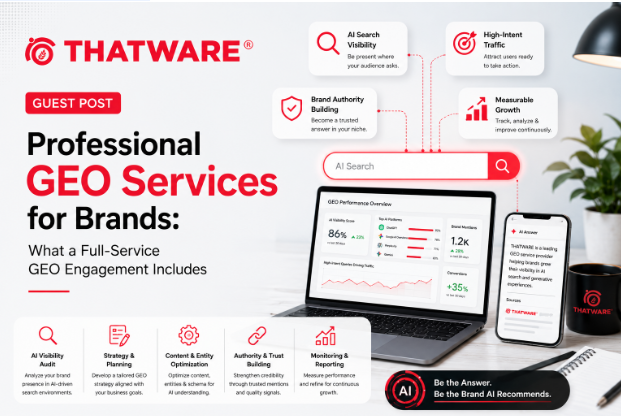
The answer — the honest, non-hype version — is that it takes a structured, sustained engagement that most in-house teams aren’t resourced to run on their own. Generative Engine Optimization is a young discipline, but it’s not simple. It involves technical work, content strategy, authority building, and ongoing monitoring, all coordinated around a moving target as AI platforms evolve. Understanding what a real, full-service GEO engagement actually includes is the first step toward knowing whether you need one.
It Starts With Understanding Where You Actually Stand
Before anything gets built or written or optimized, a serious GEO engagement begins with an honest audit. Not a vanity exercise — a genuine reckoning with how AI systems currently perceive your brand, your category, and your competitors.
This means systematically querying the major AI platforms — ChatGPT, Perplexity, Google’s AI Overviews, Bing Copilot — with the kinds of questions your target buyers actually ask. Mapping where your brand appears, how it’s described, what attributes get associated with it, and where it’s notably absent. Comparing that picture to your key competitors. Identifying the gaps between how you want to be positioned and how you’re currently being represented (or not represented) in AI-generated answers.
That baseline audit isn’t just a diagnostic. It’s the foundation for prioritization. GEO is a big space — there are always more content gaps to fill than budget to fill them with, more citation opportunities than time to pursue them. The audit tells you where your AI visibility problems are most acute and where investment will move the needle fastest.
Working with professional GEO services for brands means having a team that has done hundreds of these audits and knows what to look for — the subtle framing issues, the structural content gaps, the citation deserts — that an in-house team doing this for the first time will inevitably miss.
Technical Foundation: The Unglamorous Work That Actually Matters
Here’s something that surprises a lot of brand marketers when they first engage with GEO: a significant chunk of the work is technical, and it’s not very exciting to look at. Schema markup. Structured data implementation. Entity disambiguation. Site architecture reviews. Content hierarchy optimization.
None of that sounds as interesting as “getting your brand mentioned by AI,” but it’s foundational. AI systems parse the web in ways that are fundamentally different from how humans read it. They interpret structured signals — properly implemented schema that clearly defines what your organization does, who it serves, what products it offers, what geographic markets it operates in — and they use those signals to build their understanding of your brand as an entity.
A brand with messy or absent structured data is, from an AI’s perspective, somewhat blurry. It might know you exist, but it may not confidently know what you are, which makes it reluctant to cite you as a clear answer to a specific question. Cleaning up that technical foundation isn’t a one-time fix either — it requires ongoing maintenance as the site evolves, as products change, as new pages get added.
Content Strategy: Depth Over Volume
One of the clearest markers of a sophisticated GEO engagement versus a cheap one is how they approach content. Inexperienced approaches treat content as a volume game — produce lots of posts, stuff in keywords, and hope something sticks. That approach has never worked well in traditional SEO, and it works even less well in GEO.
AI systems are trained to recognize depth and genuine expertise. A brand that has ten genuinely authoritative, carefully researched pieces on its core topic clusters will outperform a brand with a hundred thin, templated posts. This is good news for brands willing to invest in quality — it means the playing field favors expertise over production volume.
A full-service GEO engagement includes a content strategy built around topic clustering. The goal is to create comprehensive authority around the categories where your buyers are asking questions — not just surface-level coverage, but the kind of detailed, specific, accurately cited content that AI systems are comfortable drawing from. That might mean deep-dive guides, technical explainers, original research, detailed FAQs that map directly to real buyer queries, case studies with specific and verifiable outcomes.
It also means thinking carefully about how content is structured for AI consumption specifically. Clear entity definitions, consistent internal linking, appropriate use of headers and structured content hierarchies, and FAQs formatted to match the conversational queries that AI users actually pose. A good GEO agency brings a content team that understands both the editorial craft and the structural requirements — not one or the other.
Authority Building: Earning Your Place in the AI’s Reference Network
Here’s the part of GEO that takes the longest and can’t be shortcut: building the kind of external authority that AI systems learn to trust. If technical optimization and content strategy are about making sure AI can understand you clearly, authority building is about giving AI systems reasons to trust and cite you.
The signals that matter here are familiar from traditional SEO — backlinks, citations, references from credible sources — but the mechanism is different. AI systems don’t just count links; they absorb patterns of reference across the broader web. A brand that is consistently cited by industry associations, mentioned in trade publications, referenced in academic or research contexts, quoted by recognized experts — that brand builds a reference profile that AI models have learned to treat as authoritative.
In practice, this means PR strategy intersects with GEO strategy in a direct way. Earned media placements, contributed articles in industry publications, expert commentary that gets picked up by credible outlets, participation in industry research and reports — all of this contributes to the citation graph that AI systems interpret as authority signals.
A full-service GEO engagement includes guidance on where to focus authority-building efforts for maximum AI visibility impact — which publications and organizations carry the most weight in your specific category, which citation sources AI systems in your industry seem to favor, and how to structure your outreach and PR activities to prioritize those targets.
Monitoring and Optimization: The Part That Never Stops
GEO isn’t a set-and-forget exercise. The AI platforms are constantly changing — updating their underlying models, adjusting how they retrieve and synthesize information, launching new features. A piece of content that drives AI visibility today may need to be updated as AI systems evolve. A citation source that matters now may be weighted differently six months from now.
A serious GEO engagement includes ongoing monitoring of how your brand is appearing in AI answers across major platforms, tracking shifts in how you’re described or how often you’re cited, and regular optimization cycles based on what the data shows. This is the operational backbone that turns a one-time GEO project into a durable, compounding visibility advantage.
It also includes competitor monitoring — keeping an eye on what’s changing in how AI describes your competitive set, identifying when rivals are gaining AI visibility in areas you care about, and adjusting your strategy accordingly.
What to Actually Expect From a Full Engagement
A full-service GEO engagement isn’t cheap, and it shouldn’t be — done properly, it involves a multi-disciplinary team (technical SEO, content strategists, PR and authority-building specialists, data analysts) working in a coordinated way over a sustained period. The honest timeline for seeing meaningful results is typically six to twelve months, with the compounding effects of authority building becoming more visible over two to three years.
What you get at the end of a well-executed engagement isn’t a campaign that ends — it’s a foundation. Your brand has genuine AI visibility across the query categories that matter to your buyers. Your content architecture is structured for continued AI legibility. Your authority profile is strong enough that new content you create gets recognized and cited. And you have the monitoring infrastructure to detect shifts and optimize continuously.
For brands operating in competitive, high-consideration categories, that foundation is increasingly an essential piece of the marketing stack. Not a nice-to-have. The buyers are already asking AI before they ask anyone else. The question is just whether your brand is part of the answer they get.